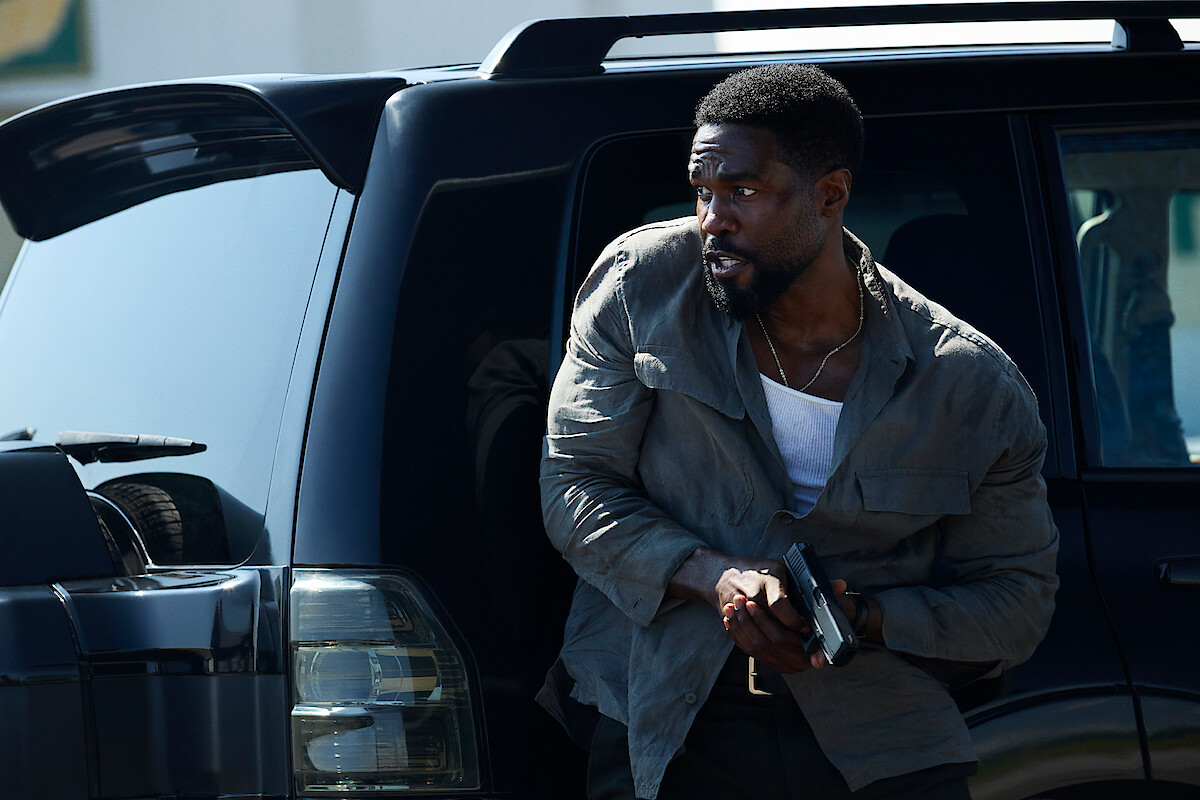
The Genesis of a Gritty Reimagining: Man On Fire Hits Netflix
Get ready to ignite your screens! Netflix is set to drop its highly anticipated drama series,
Man On Fire, on
April 30, bringing a fresh, profound take on a beloved, albeit dark, narrative. Starring the formidable Yahya Abdul-Mateen II as the iconic John Creasy, this new adaptation promises to delve deeper into the psyche of a man battling his demons while fighting for the innocent. This isn't just another action-thriller; it's a journey into redemption, trauma, and the complex human spirit, perfectly poised for the long-form storytelling a series provides. For fans and newcomers alike, the arrival of
Man On Fire Netflix marks a significant event in the streaming landscape, offering a unique perspective on a story that has resonated for decades.
Based on A.J. Quinnell's first two novels,
Man on Fire and
The Perfect Kill, this eight-episode series builds upon a foundation twice adapted for the silver screen. While many remember Denzel Washington's intense portrayal in Tony Scott's acclaimed 2004 film, and some might recall the 1987 Italian adaptation, this
Man On Fire Netflix series seeks to carve its own indelible mark. Showrunner Kyle Killen (known for
Halo and
Awake), a self-professed "gigantic fan" of the 2004 film, expressed his excitement about adapting Quinnell's "iconic" character and concept for television, recognizing the incredible potential for a more intricate narrative. This series format allows for an unprecedented exploration of Creasy's fractured mind and his arduous path toward redemption, moving beyond the temporal constraints of a feature film.
Yahya Abdul-Mateen II's John Creasy: A Study in Wounded Humanity
At the heart of any *Man On Fire* adaptation is John Creasy, a character defined by his lethal skills and profound internal struggles. Yahya Abdul-Mateen II steps into these complex shoes with an understanding that prioritizes vulnerability over invincibility. His Creasy is not just a former Special Forces Mercenary—a high-functioning professional known for surviving desolate situations—but a man now utterly plagued by intense Post-Traumatic Stress Disorder (PTSD), grappling with alcoholism and even suicidal thoughts. This raw, unflinching portrayal of a man teetering on the edge is what sets Abdul-Mateen II's performance apart.
In an exclusive interview, Abdul-Mateen II articulated his approach: "Throughout the series, (Creasy’s) never fully formed into an action hero. He is, at all times, the guy from Episode 1 who is struggling. And even as he's struggling, he's tossed into this circumstance and he is struggling at all times, all throughout the finish line to find his footing." This insight reveals a commitment to depicting Creasy as inherently human, deeply flawed, yet driven by an unwavering purpose once he finds something—or someone—to fight for. This nuanced interpretation ensures that viewers connect with Creasy not just as a protector, but as a survivor attempting to reclaim his life.
Abdul-Mateen II has also made it clear he isn't aiming to replicate Denzel Washington's legendary performance. "I don't worry about what people's expectations are in terms of comparing myself to Denzel," he stated. This confidence allows him to infuse Creasy with his own unique texture, focusing on the character's internal turmoil and fragmented journey rather than merely his external prowess. This interpretation invites viewers to witness a man's struggle to adjust to a new life, only to be thrown back into the fire, fighting harder than ever. It's a powerful narrative about personal resilience, made all the more compelling by Abdul-Mateen II's nuanced portrayal. The relationship between Creasy and the young girl he protects, Poe Rayburn (played by Billie Boullet), becomes the anchor of his redemption, pulling him back from the brink. You can learn more about his challenging journey in our related article:
Man On Fire Netflix Series: Yahya Abdul-Mateen II's Redemption Story.
Beyond the Action: Unpacking Themes of Redemption and Trauma
While *Man On Fire* promises exhilarating action sequences, its true depth lies in its exploration of heavy, resonant themes. Redemption stands as a central pillar of Creasy's story. His past as a highly skilled mercenary and CIA operative has left him scarred, and his new mission to protect young Poe Rayburn in Brazil serves as a crucible for his personal atonement. This isn't a clean, linear path; it's a messy, violent, and often heartbreaking struggle for a man haunted by his past.
The series offers a crucial, realistic portrayal of PTSD. Creasy's "wounded vulnerability" was a key draw for showrunner Kyle Killen, director Steven Caple Jr., and Abdul-Mateen II himself. His struggles with suicidal thoughts and alcoholism are not simply background details but integral parts of his character, shaping his decisions and interactions. The series doesn't shy away from the psychological toll of his past, making him an incredibly relatable figure despite his extraordinary circumstances. This focus elevates the narrative beyond typical action fare, grounding it in genuine human suffering and the long road to healing.
The choice of setting—filmed in Brazil and Mexico City—also adds layers of tension and visual richness to the story. These vibrant, often dangerous, backdrops enhance the sense of peril surrounding Creasy and Poe, while also providing a stark contrast to Creasy's internal landscape. The cultural nuances and atmospheric settings contribute significantly to the series' immersive quality, making the fight against nefarious forces feel even more urgent and visceral. This detailed environment underscores Creasy's isolation and the high stakes of his self-imposed mission. Dive deeper into how the setting impacts his fight against PTSD in our article:
Netflix's Man On Fire: John Creasy's PTSD Battle in Brazil.
Behind the Scenes: The Creative Powerhouse Bringing Man On Fire to Netflix
Bringing a story of this magnitude and emotional complexity to the screen requires a powerhouse team, and the
Man On Fire Netflix series has certainly assembled one. Kyle Killen, whose previous works demonstrate a knack for intense, character-driven narratives, serves not only as writer and executive producer but also as showrunner, guiding the overall vision. His leadership ensures a cohesive and deeply felt adaptation of Quinnell's material.
Directing the crucial first two episodes, and also serving as an executive producer, is Steven Caple Jr., known for his impactful work on films like
Transformers: Rise Of The Beasts and
Creed II. His experience in crafting compelling action sequences combined with strong emotional cores makes him an ideal choice to establish the series' tone and pacing. The visual storytelling and character introductions under his direction are critical in setting the stage for Creasy's arduous journey.
The executive producer roster is extensive and impressive, reflecting the scale of this production. Alongside Killen and Caple Jr., we have Arnon Milchan, Yariv Milchan, and Natalie Lehmann for New Regency Productions, Peter Chernin, Jenno Topping, and Tracey Cook for Chernin Entertainment, and Scott Pennington for Chapter Eleven. Notably, Yahya Abdul-Mateen II himself is among the executive producers, a testament to his deep involvement and commitment to shaping this iteration of John Creasy. Stacy Perskie for RedRum and Ed McDonnell and Michael Polaire also join this distinguished group.
The supporting cast is equally stellar, featuring a blend of established talent and promising newcomers. Billie Boullet takes on the pivotal role of Poe Rayburn, the young girl Creasy is hired to protect. Industry veterans like Bobby Cannavale, Alice Braga, Scoot McNairy, and Paul Ben-Victor round out the ensemble, promising powerful performances that will enrich the intricate web of relationships and conflicts surrounding Creasy. This collective talent ensures that every aspect of this
Man On Fire Netflix series, from its gripping action to its profound emotional beats, is handled with expertise and dedication.
Why This Man On Fire Adaptation Demands Your Attention
The upcoming
Man On Fire Netflix series is more than just another action-thriller; it's a meticulously crafted character study that leverages the strengths of long-form television to explore themes of trauma, redemption, and human connection in unprecedented depth. Unlike its film predecessors, the eight-episode format allows for a granular dissection of John Creasy's internal world, giving ample space to his battle with PTSD, alcoholism, and suicidal ideation. This isn't just about a hero saving a child; it's about a man saving himself in the process of saving another.
For viewers, this means an opportunity to immerse themselves in a narrative that is both exhilarating and emotionally resonant. Yahya Abdul-Mateen II's commitment to portraying Creasy as a "struggling" individual, rather than a fully formed action hero, offers a refreshing take on the archetype. It encourages empathy and a deeper understanding of the invisible wounds carried by many. Fans of the original books and previous film adaptations will appreciate how this series honors the core essence of Quinnell's story while bringing a contemporary sensibility to its portrayal of mental health and complex morality. It serves as a powerful reminder that even in the darkest corners of human experience, there can be a flickering hope for redemption.
In summary, mark your calendars for April 30. The
Man On Fire Netflix series is poised to deliver a compelling, visually stunning, and emotionally charged viewing experience. It's a must-watch for anyone who appreciates a story that challenges conventions, prioritizes character development, and explores the profound strength found in vulnerability. Prepare to witness Yahya Abdul-Mateen II ignite the screen in a truly unique and unforgettable performance.